While wired microphones are generally seen as something that a singer or vocalist would use in rock bands, that doesn’t mean it has no place in the hands of a DJ. In fact, microphones can be an essential part of the DJ performance as a means of interacting with the audience as directly as possible.
No, it’s not quite at the same level as a mixer and it’s never going to beat out a quality set of headphones, but investing in a reliable microphone can play a huge role in radically bumping up your stage performance and overall vocal performance.
Best Wired Microphone: Overall Choice
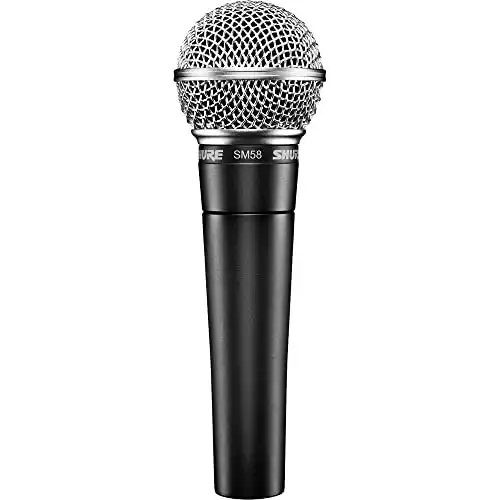
The Shure SM58 is a dynamic mic, widely used for vocal performances, live vocals, and live sound reinforcement. This dynamic microphone is known for its rugged construction, frequency range response optimized for vocals, and ability to handle high sound pressure levels.
The SM58 is a popular choice for singers, musicians, and public speakers due to its versatility and reliability.
3 Top Wired Microphone Picks – Best, Premium & Value
Below, we’ll take the time to check out some of the best-wired mics picks currently on the market while also giving you some tips on how to pick one them, use them properly, and enhance your DJ vocal performance
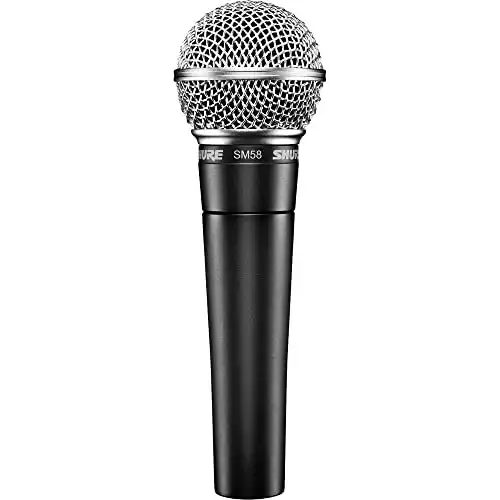
Shure SM58 (Best Overall)
Starting off our wired mics list, we have Shure’s SM58. Shure has an extensive history as a quality microphone, with the SM58 easily being one of their crown jewels. This has been out on the market for well over 40 years and is still yet to find a definitive superior to this date.
The Shure SM58 is lightweight yet incredibly durable, has a metal frame, and is given a high-quality build. The Shure SM58 weighs just over half a pound at only 0.66 lbs while its metal body is pretty much indestructible to all normal drops and falls (even two-story drops).
While I’m not a personal fan of the SM58’s style, it’s clear it has its fans. Even outside of that, the Shure SM58 mic has a host of crazy features to get into. Its frequency response range goes from 50 Hz up to 15k Hz, which is pretty much where everyone lives no matter their gender, age, or anything else they’ve done to their voice.
The Shure SM58 vocal mics come with an in-built shock mount that will handle virtually all of the excess noise, which is kind of amazing. These excess noises include grill tapping, vibrations from the cables, and any other slight noise that still gets picked up.
The only thing you have to be aware of with these wired mics s the fact that it’s upper-mid level in cost, priced at around $100, which is an incredible value when you consider everything you’re getting with the Shure SM58.
What We Like:
- Nearly Indestructible Vocal Mics
- High-Quality Reputation
- Wide Frequency Response Range & Vocal Range
- Built-in Shockmount
What We Do Not Like:
- Fairly Expensive
- Design is okay
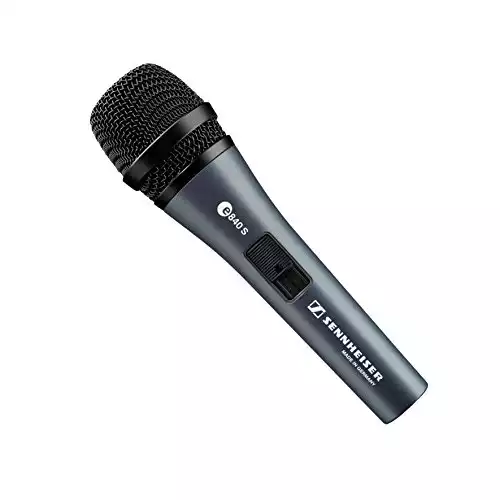
Sennheiser E840 (Premium Pick)
Coming up after the Shure SM58 on our best-wired microphone list, the Sennheiser E840 wired mics are incredibly well-built and put-together dynamic microphones.
It has a fairly rugged metal housing that is both very sturdy while also not too heavy. And when you consider its 10-year warranty, it becomes clear that this is a truly special mic option.
This particular dynamic microphone has a built-in shock mount which allows it to block out a majority of additional soundwaves. This is in addition to the silent humming the mic makes while also keeping the external noises from becoming too loud.
The E840 comes with an On/Off switch, making it easy to turn on and off when recording vocals in a studio environment or live setting.
In terms of response patterns, the E840 uses cardioid, making it useful for picking up sound directly in front of it rather than behind it or to either side.
The vocal mic has a frequency response range that is certainly quite impressive, going from 40 Hz up to 18k Hz, with the low-end able to pick up just about anyone.
These wired mics also come with a microphone clip as well as a microphone protection bag, which, while not much on their own, are great additional features that sweeten the deal that extra bit.
What We Like:
- Comes With 10-Year Warranty
- Great Frequency Response Range
- Removes Virtually All Outside Sound
- Looks Amazing and Versatile Mic
What We Do Not Like:
- The Price Is On The Higher Side
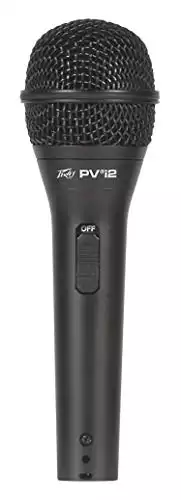
Peavey PVi 2 (Value Pick)
The Peavy PVi 2 is a handheld microphone this is great for DJs that want something with incredible sound while also at a price even a beginner can reasonably invest in. Sold at around $50, the PVi 2 comes with a plethora of different features and functions, making it seriously one of the better options on this list.
In terms of its build, the mic is made from die-cast steel, making it both incredibly dense and durable while also lightweight and easy to carry around.
It doesn’t automatically stay on, instead having an ON and Off switch, which is great since you won’t need to keep plugging it in and out whenever you want to talk or play music.
The switch is also given the same color as the rest of the body, it doesn’t stand out too much, instead being very discreet while also easy to find when using.
The PVi 2 has a cardioid response pattern, meaning you only have to worry about sounds in front of the mic rather than behind it, with the sides losing out the further to the back they are. It also comes with an XLR cable and port.
While not as long as one would like, the PVi 2 instead focuses on putting an XLR cable that is very well-made and difficult to fray or cut. And when you consider that, again, everything comes to only $50, you realize this mic is a steal.
What We Like:
- Very Affordably Priced
- Has A Surprisingly Clean & Clear Sound
- Is A Cardioid Response Pattern
- Has An On/Off Option Included
What We Do Not Like:
- XLR Cable Could Be Longer
- Frequency Response Isn’t As Wide As Others
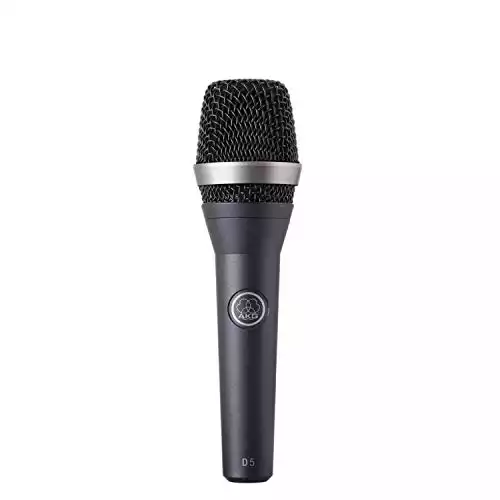
AKG D5
The AKG D5 microphone is one of the mics out there that has been established for a fair amount of time. Unique particularly to it, the D5 is known for its ergonomic design that works well with whoever uses it. It has a die-cast metal housing body and can deliver sound quite far.
Inside its housing frame, the D5 has a built-in dual shock mount that makes sure no unnecessary sounds are taken in when you’re moving the cable or tapping the grille.
In terms of response patterns, the D5 has a super-cardioid pattern, meaning that the front-facing cardioid polar pattern is even more highly focused, cutting out sounds from the sides entirely.
In terms of its frequency response range, the D5 goes from 70 Hz up to 20k Hz. And while this isn’t nearly as low as others on this list, it is still a great option for most singing and talking without any issues.
From a financial price point, while it’s an incredible and impressive vocal mic, I can see why some might be a bit resistant to its $100 price point. Still, when you consider its durability, ergonomic design, and the various features freely given, there may be a way a legitimate argument for getting it.
What We Like:
- Fairly Durable
- Ergonomic Design Feels Great
- Has High-Feedback Suppression
- Dual Shockmount Is Very Useful
What We Do Not Like:
- Frequency Response Could Be Lower
- Pricing Is Pretty High, Though Not Unfair
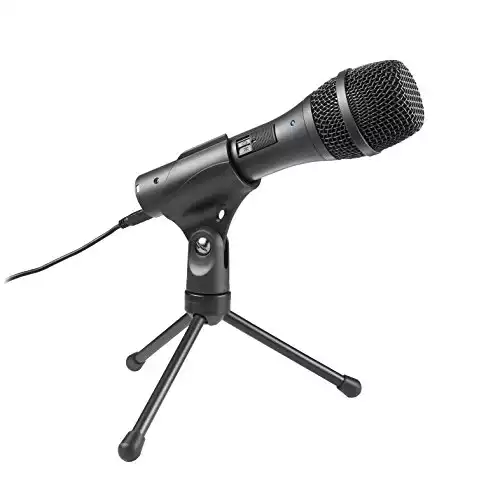
Audio Technica AT2005USB
The Audio Technica AT2005USB is a smaller handheld vocal microphone that works well in just about any situation or environment.
While it was ideally meant for the recording studio, the Audio Technica AT2005USB is just as effective out doing a live performance, flowing surprisingly well at concerts, clubs, and other open-air events.
The Audio Technica mic comes with both an XLR output port as well as a USB port. The XLR cable port is meant for plugging into most devices while the USB output is meant for plugging directly into a computer.
One of the bigger selling points with the mic is that, no matter what you’re doing, the vocal clarity is incredibly crisp and clear.
This is primarily thanks to its hyper-focused cardioid response pattern, which essentially cuts down on any unwanted excess sound. The mic also comes with a port for headphones, allowing you to hear the sounds being recorded.
In terms of frequency response rates, the Audio Technica AT2005USB can reach between 50 Hz and 15kHz allowing you to pick up even the lowest (and the highest) sound vocals.
From a cost standpoint, the Audio Technica AT2005USB is priced pretty fairly, coming in at around $80. This is pretty squarely in the mid-to-high range of wired microphones and is definitely an option for DJs that want a wide variety of uses covered all in one.
What We Like:
- Great For A Variety Of Things
- Includes An XLR & USB Output Port
- Cardioid Response Is Very Focused
- Has Headphone Jack
What We Do Not Like:
- Included USB Cable Is A Bit Flimsy
- Mic Response Is A Bit Too Focused
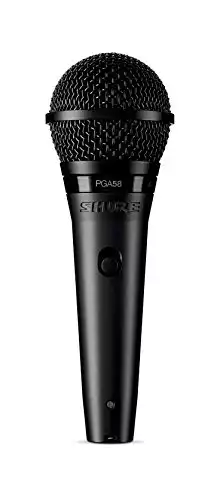
Shure PGA58
As with Audio Technica, Shure also has a stellar reputation when it comes to quality vocal microphone units. Coming with a second of their own devices on this list, Shure’s PGA58 focuses primarily on vocalists as well as those interested in a high amount of sound clarity.
It includes an On & Off switch that is subtly included in the mic’s design. In fact, because the mic itself is all-black and the switch is all-black, if you’re not paying attention, it can be easy to overlook.
The PGA58 uses a cardioid pattern, which means it focuses on sounds in the front rather than the back, giving only a little headway to either side.
This all works to help it maintain that crisp and clear sound without a ton of extra unwanted sounds showing up. In terms of its frequency response rate, the PGA58 can go from 50 Hz up to 16k Hz, handling most voice ranges, with the connection going through a 1/4th-inch XLR plug.
Interestingly, this vocal microphone is priced in the mid-range category, costing around $60. When you consider everything it offers, you’d expect it to at least be closer to $70 or 75. I think the reason for the price drop is due to the mic’s weight being a bit on the heftier side.
It’s fairly durable, however, it’s also a bit heavier than most of the other mics on this list, and while most DJs aren’t carrying their mics in hand all the time, I could imagine this being a bit of an issue for people that want to sing or talk with it in hand for hours at a time.
What We Like:
- Very Affordably Priced
- Uses A Cardioid Pattern
- Design Is Very Understated & Unassuming
- Great Frequency Response Range
What We Do Not Like:
- Mic Is A Bit Heavier Than You May Have Expected
- On/Off Switch Is Easy To Overlook Due To Design
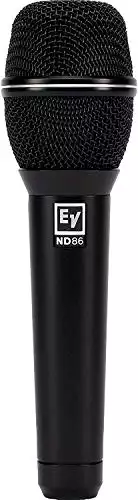
Electro-Voice ND86
A very high-quality handheld mic, the Electro-Voice ND86 makes a point of focusing on putting out some incredible acoustics and acoustic control. It has a die-cast zinc housing frame, which makes it fairly durable (though at a slight sacrifice of weight). It’s not as great as steel, but it’s a pretty close second.
This vocal microphone has a ‘memraflex’ -designed grill that significantly reduces the number of dents or scratches you’re likely to get. As far as its previously mentioned acoustic ability, the ND86 really is in a league of its own.
It can easily cut through most low-end frequencies thanks to its high-pass built-in filters. This means that the only thing you have to worry about your mic recognizing is your voice.
In terms of frequency response ranges, the ND86 can go from 70 Hz up to 17k Hz, which should handle as wide a spectrum as you’d most likely need. It also operates on a super-cardioid response pattern, meaning that it’s essentially just a much more highly focused and narrowed cardioid pattern.
This means most side noises are going to be out while also requiring you to point the mic directly in front of a person for their voice to be recorded.
And to add to its innate acoustic control, the ND86 also comes with a built-in shockmount feature which essentially cuts down on any and all unwanted sound effects that might come up from things like taps on the grill or brushes against the cable wire.
This all culminates in an incredible mic, though admittedly a bit on the pricier side of things.#
What We Like:
- Nearly Indestructible
- Memraflex Grill Can’t Be Bent
- Has Incredible Acoustic Control
- Shockmount Feature Prevents Small Noises From Getting Recorded
What We Do Not Like:
- While Not Overpriced, It’s Definitely Not For Everyone
- Super Cardioid Can Be Difficult To Transition To From Standard Cardioid
Numark WM200
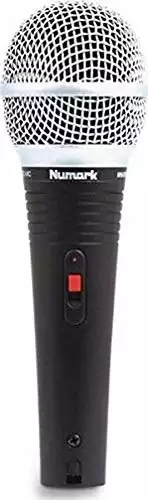
If you’re looking for a mic that is super affordably priced, making it accessible to just about everyone, then you’re going to love what Numark’s WM200 has in store. We’ll get into how much you’ll pay for this microphone in a minute. First I want to go over some of its different features.
Right off the bat, this is a cardioid-pattern mic, meaning it’s perfect for single-person and back-and-forth conversations, as only the front and some of the sides can actually have their sound recorded.
The mic’s body also includes an On/Off switch so that you don’t have to worry about constantly plugging and unplugging it whenever you don’t want to talk at any exact moment.
In terms of build, while it’s not quite as dense or as durable as others on this list, the WM200 vocal microphone is easily one of the lightest options out there, meaning you can pretty much hold this mic in your hand indefinitely.
For most club and mobile DJs out there, it’s unlikely you’re going to spend a bunch of time singing to your audience. As such, while the WM200 doesn’t have the highest sound clarity in the world, it’s going to be more than good enough for most people, especially those getting started.
Where it does draw back a little is in its wired XLR cable, which is only around 20ft. Similarly, the On/Off switch is a separate design from the rest of the mic, which can be a bit distracting. Again, considering its price point, it’s not nearly as big of an issue as it would be at the higher levels.
And what is its price exactly? Well, incredibly, the WM200 only costs around $30. That’s easily one of the most affordable options out there and the most affordable option on this list.
What We Like:
- Super Affordable (Only $30)
- Super Lightweight
- Solid Frequency Response
- Has A Cardioid Polar Pattern
What We Do Not Like:
- Not Ideal For Non-DJs
- Overall Design is Average
When Would You Need A Wired Microphone?
DJs can often use a dynamic microphone or a condenser microphone for the same reason many other people use microphones.
However, you’re likely to find yourself relying on a quality mic based on the nature of the music you’re putting out as well as the venue you’re in. As an example, a DJ that performs Electronic or House music is less likely to find themselves using a mic simply because they rarely expect to interact with their audience.
On the other hand, if you’re into the EDM commercial genre, odds are there’s going to be some level of interaction you’re going to have with the crowd. If that’s the case, having a quality microphone offering excellent sound quality is pretty much essential.
The same is true for radio DJs, which do just as much talking to their listeners as they do performing. Crystal-clear sound quality is essential!
Similarly, where you’re performing can play a big factor in whether or not you need a microphone. DJs that operate at a club or large party venue may not need it nearly as much as a mobile DJ that’s performing at a wedding or birthday party.
What To Consider When Buying A Microphone
Before we get into some of the best-wired microphones available, let’s take a bit to determine what factors you should consider when deciding on what you need for your performance.
After all, the type of dynamic microphone a club DJ needs is probably going to be different than what a mobile DJ or a radio DJ needs.
Pricing
The first thing you want to consider is your budget and how much you want to spend on a live vocal microphone. Like most pieces of DJ equipment, there is a healthy range in prices.
On the cheaper end, there are some dynamic microphone options out there for around $20-50, while at the higher end, you can get a microphone that can easily set you back $300. If you’re just starting out, a good budget is give or take going to be around the $100 range.
Durability
Durability and build are also important things to consider. Some mics are made sturdier than others. Durability can come at the cost of sound quality if it’s too dense, while there are other mics that, while maybe less durable, are more lightweight or able to pick up more sound.
You should ideally be looking at a mic that is at least somewhat durable and preferably made from metal rather than plastic.
Frequency Response Pattern
Generally, there are three types of response patterns a vocal microphone can have: omnidirectional, figure-8, and cardioid.
Microphones that have an omnidirectional pattern pick up sound equally from all directions, while figure-8 pattern mics pick up sound in front of and behind – with no sound on either side.
Cardioid polar pattern mics have the sound picked up primarily in front of it, with the sides picking up less and the rear not picking up anything.
For DJs, you ideally want a cardioid polar pattern mic as these will allow you to perform without picking up any backlash from the crowd or your speakers, instead only noting what you have to say.
In addition, there are also hyper-cardioid and super-cardioid wired mics, which essentially narrow the range even more so that there is much less outside noise interfering thus offering a very natural tone.
Additional Features
Lastly, you want to take some time to see if there are any additional features included with the mic. This may mean things like included cables or included cables that are longer and more durable than some of the more standard options out there.
Features could also include things like a shock-mounting capsule or an included mic stand. While additional features shouldn’t be a dealbreaker, they should be seen as potential tiebreakers.
If you’ve got two great options overall, it may be better to opt for the mic with a few added features even if the price is slightly higher.
Of course, while these factors are important, it’s also just as important to know that not all wired mics are built the same. Below, we’ve curated a list of some of the best wired DJ microphones available in 2023.
Now that you have an idea of what to be on the lookout for, take some time and look them over and see if any can help you in your DJ journey.
FAQs
1. Can I Use A Condenser Mic During A Live Performance?
A condenser mic can be used during a live performance if you’re in a pinch, however, it’s most optimal when operating in a recording studio.
This is because your condenser mic is meant to hit the more delicate and higher-end frequencies that may get lost during a live performance. Generally, studios are more geared for picking up treble sounds as they have soundproof spaces to reduce what manages to escape the room.
2. What’s The Difference Between A Condenser & A Regular Mic?
The biggest difference between the two mic options is the sound frequencies they can pick up. Such as background noise, stage noise, unwanted noise, and possibly a nearby human voice.
Unlike condenser mics, which tend to pull from higher frequencies, a regular mic is optimized to recognize and pick up louder sounds with a stronger and more powerful boom to them.
This difference is largely technical since both can be interchanged for the other, though there will be a bit of loss in sound quality.
3. What Live Vocal Mics Work Best?
This depends greatly on the type of DJ you are, the level of vocal performance you wish to achieve, and the venues you tend to frequent.
As an example, if you’re a DJ looking for something more for the studio, you’ll probably enjoy the Audio Technica AT2005USB. For those that want something with some alternative uses, you’ll probably want to check out the Numark WM200.
Wired Microphones For DJs: The Verdict
Regardless of what type of DJ equipment you want, you must always consider the quality of the item you’re getting. It doesn’t matter if it’s a DJ controller, a studio speaker, headphones, or even a microphone, you have to make sure you’re getting the device that is right for you.
By following the points made earlier, and seriously considering the options listed above, not only should you be able to have a good idea of what type of live vocal microphones you want, but you may even be able to get the exact one you need.
If you do plan to use live vocal mics as a DJ, my advice would be to use them. So many times, it can be easy to fall into operating your music and ignoring the mic in front of you.
If you think it’s important for your DJ and live vocal performance, make sure you’re using as much as you reasonably can, making sure to always keep your crowd as engaged and into your music as possible.