
Pioneer DJ is a company that has gathered a lot of reverence throughout the years. Their flagship gear is known to be the cream of the crop when it comes to DJ equipment. You will be hard-pressed to find a state-of-the-art club without some of the brand’s units.
Pioneer DJ’s top mixers and CDJs cost a pretty penny, there is no way around that. However, in recent years the company has started leaning into the beginner-friendly market. The company’s efforts to create budget-friendly options of its gear have been praised by many due to the great results.
In 2016 Pioneer jumped into the well-populated entry-level studio speaker market with the Pioneer DJ DM 40 set of speakers. Their street price is indeed a stunner. At around £130/€150 for a pair, the monitors could hardly be any more affordable.
Anyone familiar with professional audio gear knows that, usually, one gets what one pays for. However, Pioneer DJ may be out to prove a point here. Could this be the deal of the decade, or are the speakers just a gimmick flying under a big name? Let’s find out.
No products found.
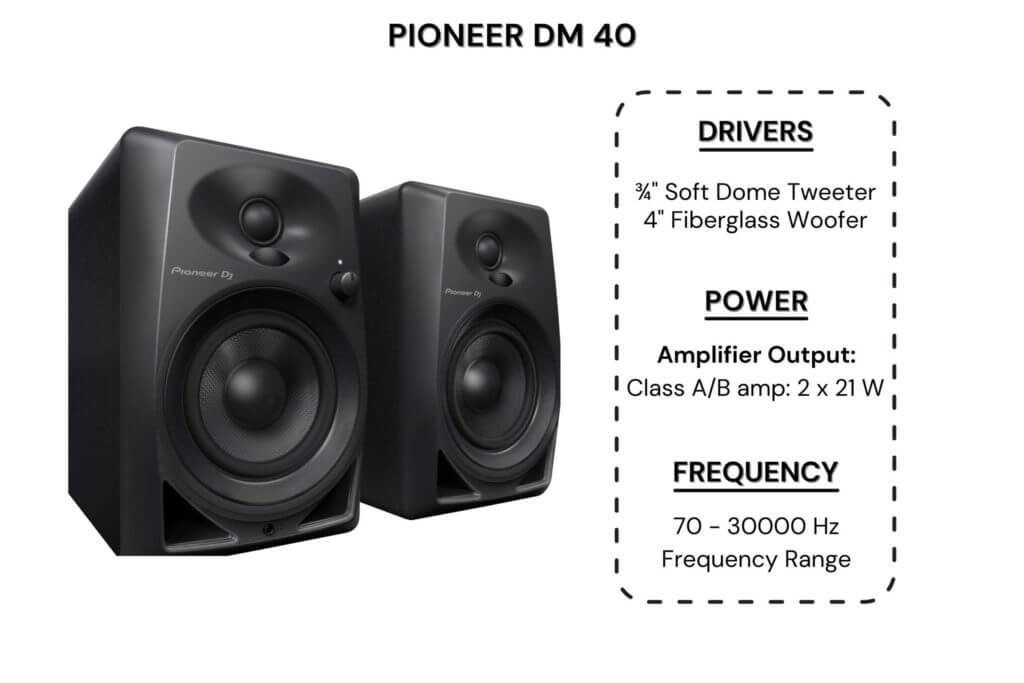
Pioneer DJ DM 40 Specfications
| Speakers | · Type: 2-way bass reflex, active monitor speakers · Tweeter: ¾-inch Soft Dome · Woofer: 4-inch Fiberglass |
| What’s in the box | · DM-40 x 2 · Power cord · 2 m speaker cable (for left/right channel connection) · Audio converter cable (3.5 mm stereo mini-plug to RCA) · Bottom cushion x 8 · Operating instructions |
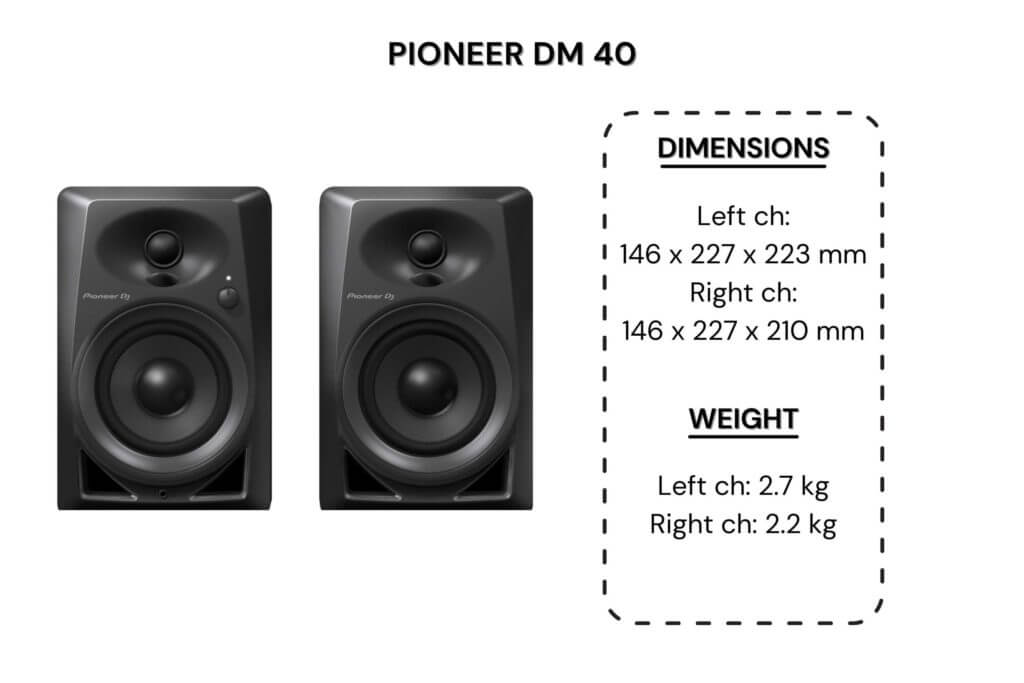
| Dimensions | · Left ch: 146 x 227 x 223 mm · Right ch: 146 x 227 x 210 mm |
| Weight | · Left ch: 2.7 kg · Right ch: 2.2 kg |
| Amplifier Output | · Class A/B amp: 2 x 21 W / 4 Ω |
| Frequency Range | · 70 – 30000 Hz |
| Impedance | · 10 kΩ |
| Inputs | · 1 LINE (RCA) · 1 LINE (Mini-jack) |
| Outputs | · 1 HEADPHONE MONITOR (Mini-jack) |
Pioneer DJ DM 40: Features
DECO Convex Diffusers
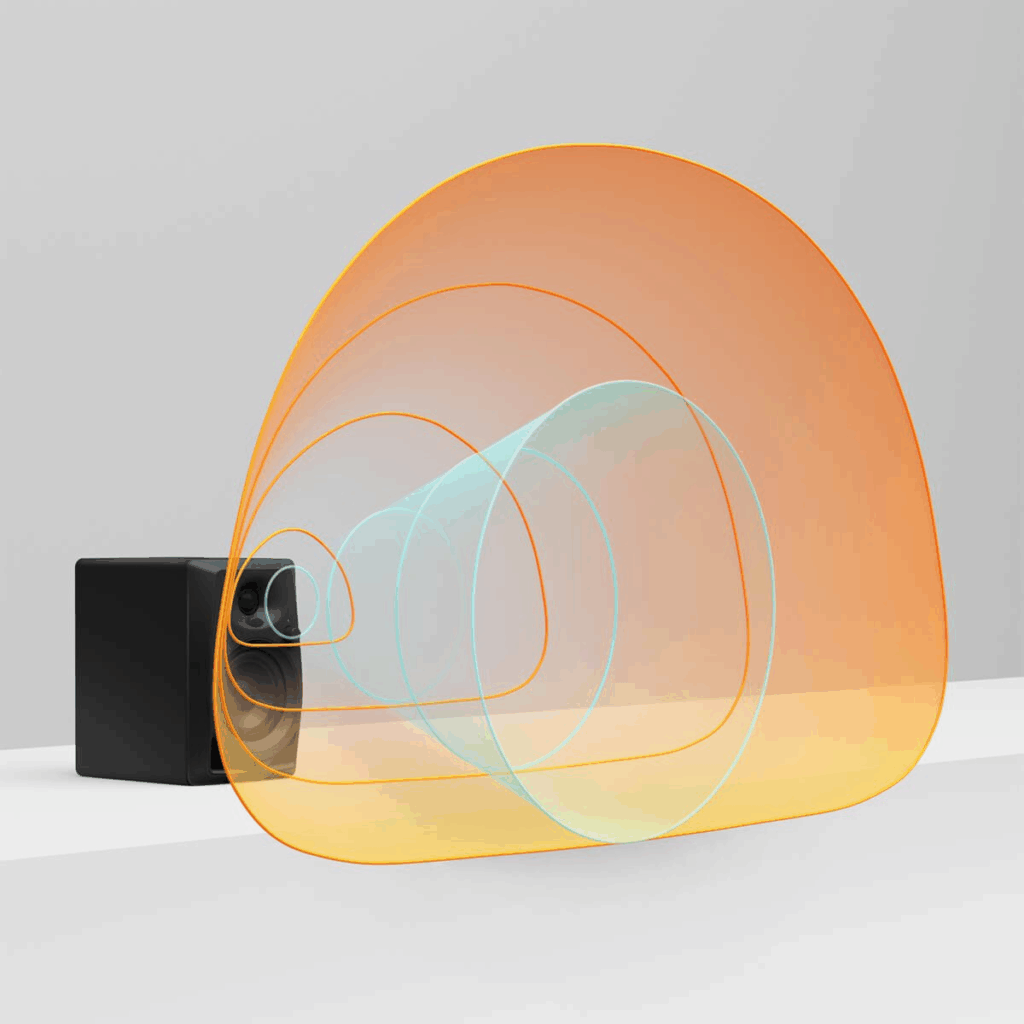
The DECO convex diffusers are mounted in the tweeters of the Pioneer DJ DM 40s, ensuring that the high-frequency content is distributed evenly in each direction. The diffusers widen the sonic sweet spot of the Pioneer DJ DM 40 monitors. Practically this means that the sound quality does not decrease drastically depending on your location in the room.
Front-Loaded Bass Reflex System
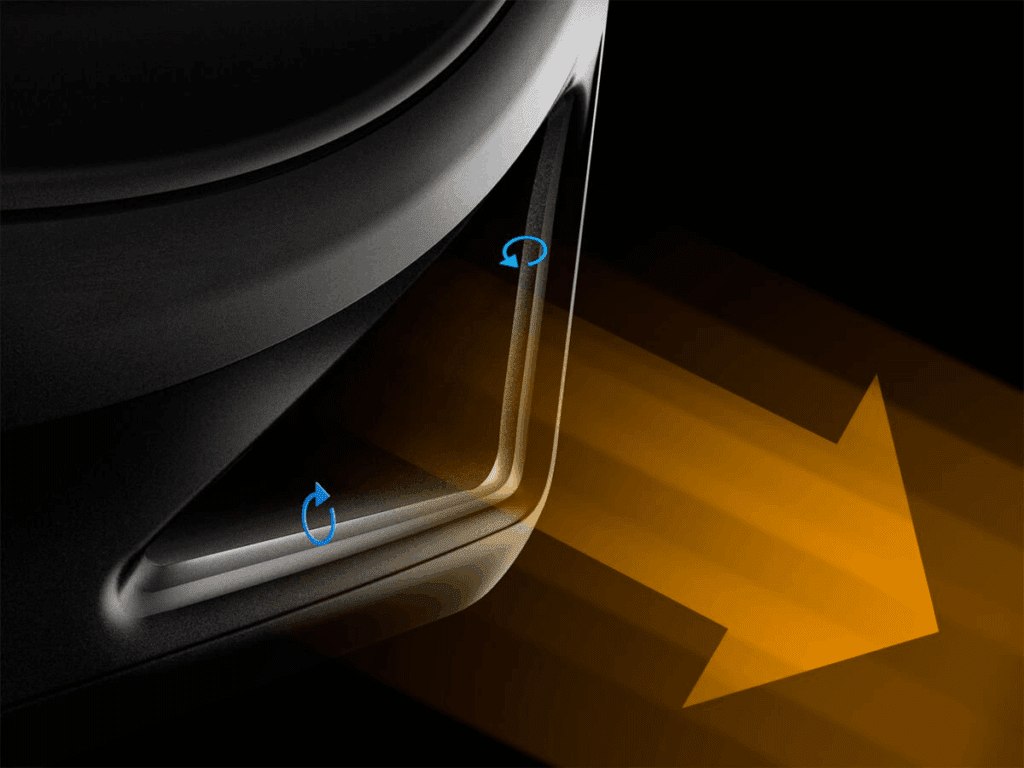
The Pioneer DJ DM 40 speakers are cut out to have impressive bass, first and foremost. The specially engineered ducts cut down on impediments and produce a clean, grand, low-end oomph regardless of your volume levels.
Class AB Amplifiers
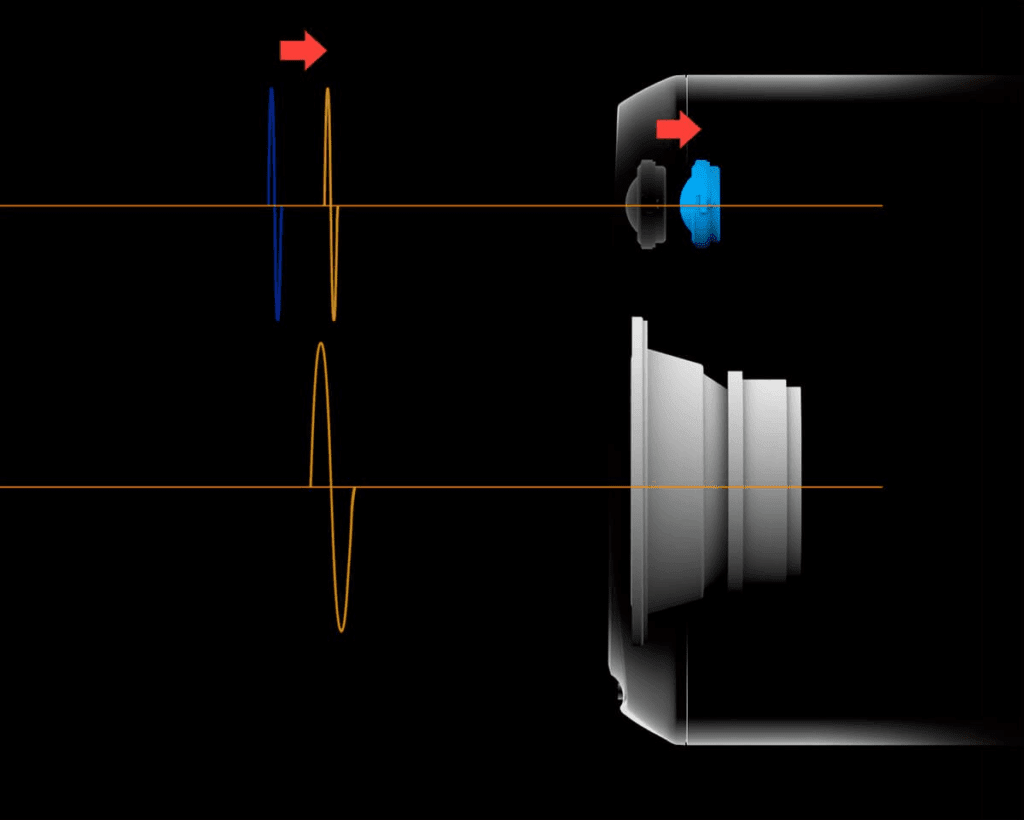
The amplifiers in the Pioneer DJ DM 40 speakers are designed to ensure minimal levels of distortion, even when cranking the volume. The tweeters and woofers are both aligned with each other so that there is no crossover between them. That translates to a more balanced overall frequency response.
Connections
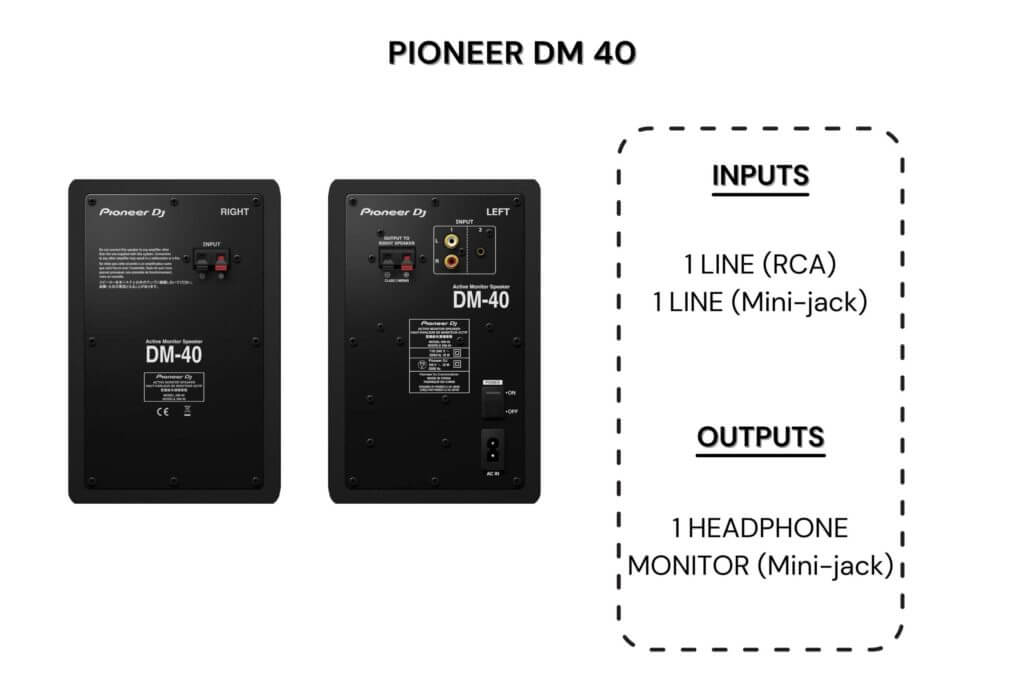
According to Pioneer, the Pioneer DJ DM 40 units are made to be very user-friendly when it comes to connectivity. There is a headphone port at the front of the master speaker for easy access when you want to switch to a different listening experience.
Efficient Design
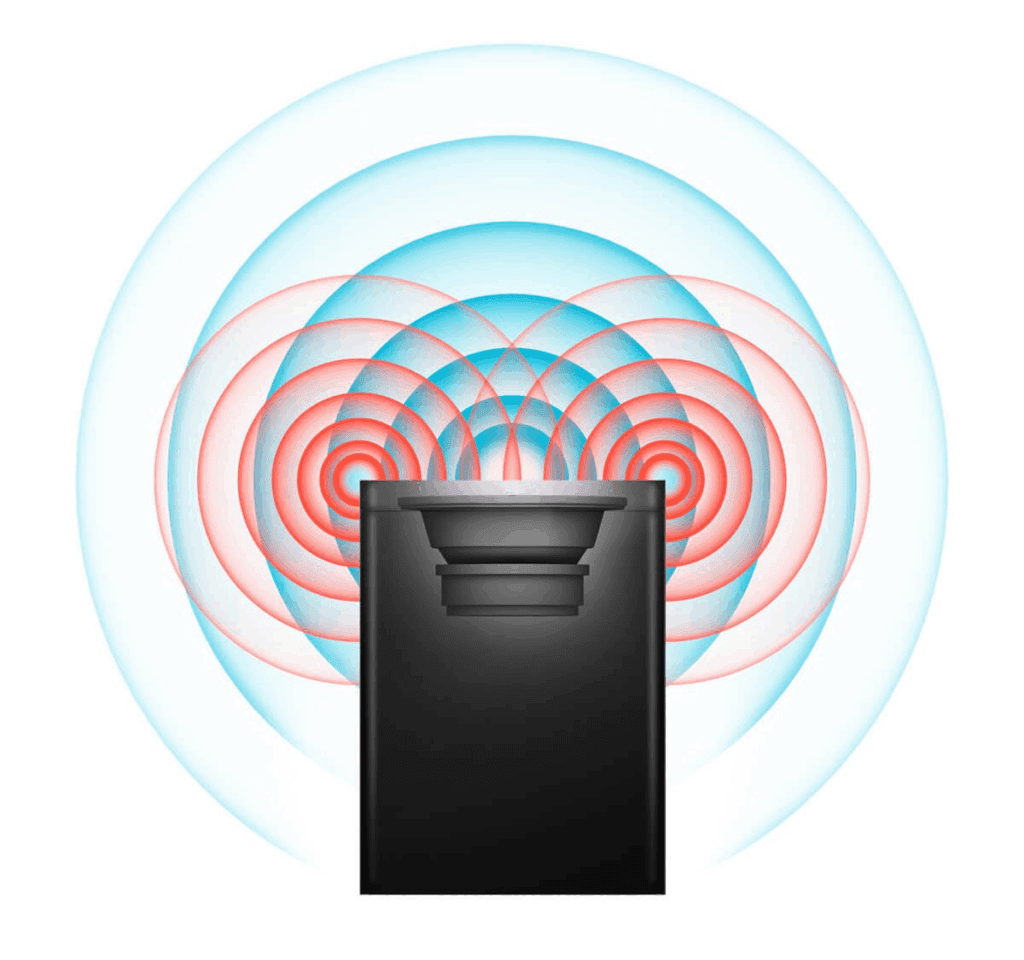
The Pioneer DJ DM 40s have a sleek design that is quite unique. The front edges are curved – this is not only to impress visually but also to minimize the unwanted resonance of frequencies. According to Pioneer, this helps the DM 40 speakers achieve it’s impressively low-distortion at high volumes.
First Impressions / Setting Up
The Pioneer DJ DM-40s come in a pretty small size factor. They aren’t so tiny and light that this would be a selling point, but the speakers sure won’t crowd your room. They are not as lightweight as they may seem, but that is indeed beneficial. Many of the low-tier cabinets are made out of plastic, whereas the DM 40 speaker cabinets are made out of wood.
This is a nice surprise at the low price point. Wood helps to stabilize the cone movement, thus making for a tighter sonic punch. Anecdotally, people also say that over time the tone of a wooden cabinet improves. The DM 40 Pioneer DJ speakers are front-ported, which minimizes the problematic sound reflection issues of putting them too close to a rear wall.
However, there are no ways to customize the sound of the speakers via EQ cuts or boosts. The Pioneer DJ DM 40s do not extend themselves to overcomplicate things – you get what you see.
The Pioneer DJ DM 40 monitors are sold as a pair. One of them is the master speaker – it has all the inputs and volume controls, whereas the other acts as the slave speaker.
The master speaker has a power-on light indicator in the front, as well as RCA and 1/8 inch TRS inputs at the back. The volume is controlled by a rotary knob on the front panel of the master speaker. The slave speaker only has wire inputs on the back to connect the pair.
The inputs are certainly not extensive enough to suit a variety of applications, but they cover the essential needs. In any case, adapters can be of help if one wants more options.
The Pioneer DJ DM-40s come with two-meter long audio cables, power leads, and some foam cushions that act as miniature isolation pads. They help to soak up the reverberations emitted by the speakers, thus keeping the sound direct.
These are especially helpful when placing your audio setup on a table because the table can act as a speaker extension itself. Any kind of foam will be helpful to reduce the sonic skewing that might be going on.
Ideally, you want to have dedicated floor speaker stands, if your place allows for them. Having them increases the spread of the sound image and minimizes the vibrational bleed of the cabinets.
The second-best option is getting desk stands, and the third-best option is having some foam cushions, which Pioneer DJ kindly supplies with their speakers.
Getting your room acoustics on point is half the battle when it comes to making the best out of your audio system. The design of the DM 40s addresses the fact that many bedroom DJs and producers may not have an ideal sonic space to work with.
According to Pioneer DJ, the curved front edges help minimize undesirable sonic reflections and the DECO convex diffusers aid in making the sonic sweet spot as wide as possible. These solutions also make for an intriguing design. It may be a matter of taste, but the Pioneer DM 40s look fairly sleek for a budget pair.
They are not attention-grabbing, but that may be a good thing. Pioneer DJ kept it minimal and classy with their aesthetic solution. However, let’s get to the main question. How do they sound?
Pioneer DJ DM-40: In Use
After turning up the Pioneer DM 40s, it is safe to say that they sound pretty large for their size. The most distinct aspect is the bass response, which is abundant. The speakers produce a thick thump that makes for a great feel when engaging with music. Especially if you want to practice your DJing skills, having a pair of speakers that make you want to move is an essential point to cover.
Pioneer DJ know their ways around the dance world, and this knowledge seems to have seeped into building the Pioneer DJ DM 40 speakers. On the other hand, the sonic high end of the monitors is not as impressive.
No products found.
It comes across as a bit restrained, even rounded off. One could consider the sound being warm, but that is taking an optimistic perspective. The Pioneer DJ DM 40 monitors are missing some strength and accuracy in the top end. Each speaker has 21W of power behind them – this is not a lot, but more than enough to practice your mixing skills comfortably, casually enjoy music, movies, and games.
Theoretically, the Pioneer DJ DM 40s lack power for playing a party, but it could be pulled off if you have a small room and some enthusiastic dancers. What does stand out is that Pioneer succeeded in delivering on their promise of low distortion. Even as the speakers get quite loud, there is no noticeable harshness.
Only after the volume is above 70%, one can start to notice unpleasant artifacts coming through. However, having them blast at just below that amount will be more than enough power for most casual uses.
The low end is most certainly accentuated on the Pioneer DM 40s. Whether that is good, depends on what you want from your monitors. If you plan on only practicing DJing, as well as enjoying some casual listening, then the extra punch can be seen as an engaging boost. That is especially great for DJs who are constrained by a volume limit in their homes.
Having the speakers play on low volume, yet still thump is pretty neat. It keeps things exciting and makes you want to keep playing, moving, and grooving. If you are looking to mix your songs in order to translate well on a variety of audio systems, then the Pioneer DJ DM 40s are not what you are looking for.
However, it should be stated that, for the price, the Pioneer DJ DM 40 speakers significantly punch above their weight class. They sound great in their own right and blow the competition out of the water in the price range.
Who They Are Made For
The Pioneer DJ DM 40s are best suited for beginning DJs and entry-level audiophiles who seek to upgrade their computer speakers. They deliver an engaging and exciting sound that fills the room when practicing at the decks. When compared to conventional computer speakers, then the DM 40s come across as a vast improvement.
However, they are not suited for professional applications. In the case that you enjoy or need your monitors to be accurately representing soundscapes, then you should consider investing a little more money into your audio system. That is especially true if you are looking to get into music production, mixing, and mastering.
Studio monitors are probably the most important sonic tool to help you create and shape your music – they are, essentially, your digital ears. If you are serious, then double the price can get you some truly outstanding budget speakers, such as the Adam T5Vs.
If you are hard-pressed to invest more into your monitoring system, then you can rest assured that the Pioneer DJ DM 40s will still be impressive for your DJ practice, and casual listening. We would also like to make clear that it is also entirely possible to produce music on sonically inaccurate speakers.
One’s budget-pick should not be a psychological limit on what you can or can’t do with your gear, but it will make things more cumbersome. In any case, a quick search through some customer reviews will tell you that most people are over the moon with the price/quality ratio of the Pioneer DM-40s.
While one will not experience the bliss of intricate sonic details, the overall quality is impressive at such a low price.
No products found.
Pros
- Extremely affordable
- Simple to use
- Small size
- Astounding sound quality for the price
Cons
- No balanced Input
- Headphone port won’t mute speakers entirely (sometimes)
- Frequency response is not accurate enough for pro use
Pioneer DJ DM 40: The Final Verdict
The Pioneer DJ DM 40 models are excellent monitors for the money. They are targeted at entry-level enthusiasts, and they sure manage to deliver a quality that far surpasses common computer speakers.
For bedroom DJs and casual listeners that are looking for the best DJ speakers without busting the bank, these monitors will surely bring a whole lot of joy. However, we can not pretend that the DM 40s fall into the pro category. For what they are, they make an excellent bang for your buck. At this price point, it would be a lot to ask for much more. Still, any serious audio enthusiasts should definitely invest more into their speaker system. Overall, for those who like monitors that are more vibe-oriented than accurate, the Pioneer DJ DM 40s are well worth considering.