How does soundproofing work? Good question! There’s a lot of talk about the importance of soundproofing and the use of acoustic treatment foam panels. For many people starting DJing or music production, it may be a bit confusing about what you’re actually doing, how to block sound, or even how soundproofing actually works.
While effective to a certain extent, the soundproofing process to block noise or create a significant noise reduction can be very expensive to perform while also more than a bit difficult to fully implement.
While soundproofing foam panels may seem like the ultimate solution for blocking out all of those pesky sound waves, the truth is that they can only do so much.
Sure, they may help a little bit, but a lot of those pesky frequencies will just bounce off the walls, ceiling, or floor like a game of acoustic ping pong.
Foam panels can still be useful in reducing the overall noise pollution, in your space, which might make your neighbors or roommates a little less likely to knock on your door with angry complaints.
Yep, you don’t want to be branded the noisy neighbors!
So, while they may not be the ultimate soundproofing solution, foam panels are still worth considering if you want to keep the peace (at least to some degree).
Overall, it’s important to keep in mind that achieving true sound transmission proofing often requires more comprehensive and specialized measures, such as the use of thick, sound-absorbing material and proper sealing and insulation techniques.
How Does Soundproofing Work?
Simply put, soundproofing is the process of blocking out and reducing the transmission of sound both into and out of a specific area. Soundproofing will be used in recording studios, venues, and homes to reduce how much sound or loud music can be heard externally. In short, it will stop sound pollution and unwanted noise.
No products found.
What is Soundproofing Foam?
Soundproofing foam works by using a physical process called dissipation, which involves converting acoustic energy into heat. This process helps to reduce the overall level of noise within a space.
The process of dissipation occurs primarily in porous materials and is commonly seen in textiles such as carpets or curtains.
As sound waves bounce around within these materials, they create friction which converts the energy into heat and absorbs the sound energy.
While these everyday materials can offer some level of noise reduction, there are now specialized materials specifically designed for this purpose that offer more effective results.
Examples of these materials include mineral fiber and polyethylene foam, which have excellent absorption capabilities. It is important to note that the effectiveness of these materials can vary based on their specific properties and the specific requirements of a given soundproofing application.
One of the biggest factors that go into determining the effectiveness of soundproofing foam is its thickness.
The thickness and size of soundproofing foam can greatly impact the overall effectiveness of reducing noise.
A dense material will generally absorb more sound waves, while larger materials may also provide better performance. It is important to consider these factors when selecting and using soundproofing materials to ensure optimal results.
Sound Insulation Science
When sound leaves a speaker and hits any sort of wall or structure, three possible outcomes may occur depending on the situation:
- Nothing Happens: In this instance, sound waves more or less just pass through the wall without issue.
- They Are Absorbed: Rather than simply passing through, the sound waves are instead absorbed and dissipated into the wall or physical structure.
- They Are Reflected: Also known as being “bounced back”, the sound waves are reflected into the room and away from the wall. This follows the law of the angle of incidence is equal to the angle of reflection.
While all three of these scenarios are likely to happen, which one that does happen is largely based on the frequency of the sound wave and its overall wavelength.
Generally, the wavelength describes the physical longitude required for a wave to complete a cycle. Lower frequencies will have longer wavelengths while higher frequencies will have shorter ones.
To give you an idea of how the two correlate with one another, here are a few examples of a frequency and its corresponding wavelength
- A Frequency of 20 Hz will have a Wavelength of 17m
- A Frequency of 100 Hz will have a Wavelength of 3.4m
- A Frequency of 1 kHz (1,000 Hz) will have a Wavelength of 34 cm (0.34 m)
- A Frequency of 2 kHz (2,000 Hz) will have a Wavelength of 17 cm (0.17 m)
In order to effectively influence a soundwave, the object in question must have a depth that is at least a quarter (1/4th) of its wavelength.
This means that, regardless of either reflecting or absorbing the sound energy, a soundproofing foam that doesn’t have at least that quarter of the wavelength established will be wholly ineffective.
It’s actually because of this that you generally will hear only a bit of noise through a door, or will have an easier time hearing the bass from the music outside.
This is because higher frequencies are much more easily absorbed compared to lower bass frequencies, which have much longer wavelengths and can thusly move through most materials easier and with less obstruction.
No products found.
How Do I Soundproof My Room?
As mentioned earlier, soundproofing a room can be a difficult and expensive task, especially if the studio room is already built.
Generally, the easiest method of reducing sound is by just making thin walls into thicker walls. Thick walls are a great option if you’ve got the resources and are building the room at the time.
However, for most people, building thick walls are going to be more than a bit unreasonable and unlikely. You could try adding a layer of drywall on either side of each wall, but even this can be a pretty expensive task and something few people will want to undergo.
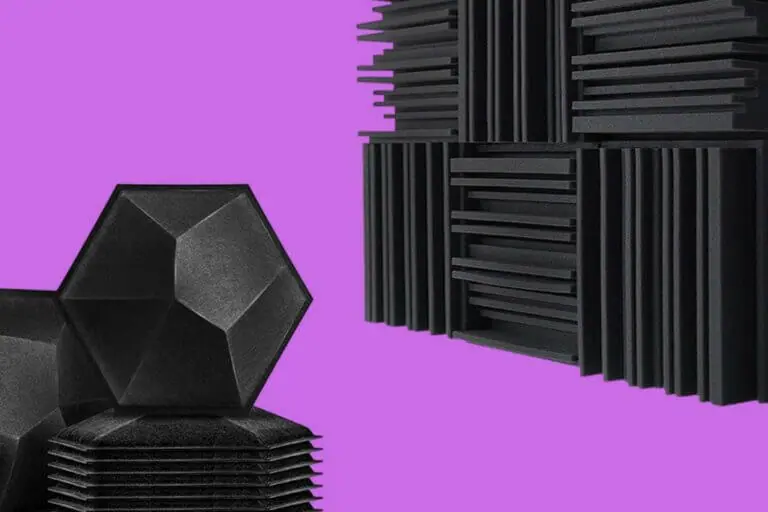
The most accessible and affordable method for soundproofing a room is by implementing sound absorption foam panels.
Also known as acoustic panels, these are the most effective method you’re going to find in cutting out sound from the outside world.
This process is known as “Acoustic Treatment”.
No products found.
What is Acoustic Treatment
Acoustic treatment is the process of applying foam panels to your wall. These panels are able to absorb sound waves while also shortening the overall reverberation time in the room. Generally, this time ranges between 0.25 and 0.4 seconds as an ideal, but this can vary.
RT60 (Reverberation Time 60) is the amount of time it takes for sound pressure levels (SPL) in a room to decrease by 60 dB. This goes along with 1/1000 of the original SPL.
Acoustic panels will often come with a table that includes their absorption qualities based on the frequency band. This is physically represented by the alpha symbol. So, if a foam panel has an alpha score of 0.6 at 1 kHz, that panel should be able to absorb around 60% of all soundwaves sitting in this frequency band.
With this general understanding, you’ll be able to know what acoustic panels are ideal for absorbing sound energy. You can even amplify some of these effects by mounting the panels to the wall at a distance.
This will improve the low-end frequency absorption rate a bit better than normal.
But absorption isn’t the only area that acoustic panels help. If you remember earlier, three scenarios happen when sound waves hit a wall: nothing, absorption, and reflection. We’ve already talked about absorption and how it negates a large portion of “nothing”, but what about instances of reflection?
Early Reflections
Generally, acoustic panels are able to absorb sound and reflections quite effectively, the most important point to worry about is “early reflections”.
Early Reflections happen between 1 and 50 ms after the initial signal. These early reflections can create a false perception of the room’s size, coloring the sound a bit. Acoustic foam panels placed on the walls and ceilings can eliminate a vast majority (if not all) of these early reflections, provided they are set properly.
To set this properly, you take a mirror and slide it across the ceiling and walls. If you can see any sound speaker through the mirror reflection, know that that is where you need to put a foam panel.
Sound Diffusers
While there are a number of different panel types that exist out there, they all generally make the point of absorbing sound and eliminating unwanted sound. This is very different from sound diffusers, which are designed to operate by reflecting sound waves.
This is done by taking a block of reflective material (often wood) and placing it irregularly on an acoustic element.
Rather than being absorbed, these soundwaves will instead be scattered in many different directions. This eliminates direct sound reflections while also breaking the law of the angle of incidence is equal to the angle of reflection.
Sound diffusers are ideal for handling direct reflections that may come from your back wall even while your acoustic panels handle the early reflections. Diffusers will also help handle early reflections much easier, scattering the sound and creating a “diffuse sound field” and giving the room a much more natural feeling.
Both methods are ideal for handling reflections. It’s difficult to say which is inherently better, but foam panels are considerably easier to apply, which may make them the slightly better option.
No products found.
How Soundproofing Works: Summary
There is a lot to know and learn when it comes to sound absorption and acoustic treatment, soundproofing your walls, and the different foam panel options.
If done correctly, you shouldn’t have to worry about sound ever coming in or out of your room, so pay attention to what you’re doing and the type of panels you end up getting.
Great options like Polyethylene and Basotect are some of the first options worth checking out, but be mindful of the panel shape as well, as these also play a serious impact in your efforts to block noise.
Invest in the correct type of soundproofing material, absorb the sound and avoid the label of being the unwanted noisy neighbours!